My kinders are learning about the lines and spaces of the music staff (we're past the whole -higher/lower, two lines, three lines, sort of prep stuff). I have a really cute activity for lines and spaces that involve stars that I'll post about later.
For now, here's an idea that I've used with past week:
The large staff is a painted shower-curtain (easy and surprisingly durable).
The penguins are little figures I made and then cut out and laminated (also pretty durable).
To play, I move the penguins off the staff and tell the students a blizzard has happened. We wave our hands up and down while making a "whoo" sound (like the wind blowing).
Then, we sing this (to the tune of "I'm a little teapot")
I'm a little penguin on the staff Watch me waddle and try not to laugh Can you please help me find my place On a line or on a space
While we're singing, I choose a student to put each penguin (one by one, so we sing 5 times for the lines and 4 times for the space) on the correct place.
Since my 1st graders are super busy with the music for their Winter Program, this year my Kinders (yes, Kinders - they are doing so well) are working with Thanksgiving Rhythms (you can find this activity and other lessons and printables in this download from my TPT store):
First, we discuss each food you see below:
Then, we sit in a circle and chant (while keeping the steady beat): We will eat your dinner, Whatever you might pick, But we won't eat those monkey brains 'Cause that will make us sick!
We pass around a little stuffed turkey while we chant this. Whatever child the turkey lands on chooses a food, and then we figure out the rhythm that goes with the food. (The kiddos are pretty solid on "ta" and "titi", so now we're working on combining them into two or four beat phrases)
So:
Quarter Note: corn, bread
Eighth Note Pair: gravy, turkey
Eighth Note Pair and Quarter Note: casserole, pumpkin pie
Once we know what the rhythm of the food is, we turn it over and it is "eaten". The kiddos enjoy it and the whole activity doesn't take too long to complete.
With my 1st graders, we usually complete this worksheet:
I don't know about you, but cutting and pasting with kinders is just not something I want to do. To practice the rhythms this year, we're using Amy Abbott's wonderful set of "Thanksgiving Dinner Rhythms". The kinders are only using "corn" and "turkey" but they're having fun creating the rhythms. Then, we move them to high and low pitch levels (prepping for so and mi) and use our singing voice.
Hello everyone! I recently updated the freebie, Mrs. White, in a major way. You'll find: 1) slides for teaching the song, 2) printables (worksheets, steady beat tracking pages, etc), 3) 3 explicit mini-lesson plans. Please take advantage of this wonderful poem during the Halloween-season.
Don't forget to pick up your ghost erasers from Target. They are just too cute!
*****This file is also included in my Fall into Music set.*****
My kinders and I are having a fun time with kitty cat songs. I have a cute little grey stuffed cat named Juba that the students love to sing a play with. There is a little song called "Juba", but I'll have to add that later as the music is at school - whoops.
We are big into "I can" statements this year, so:
1. I can use my singing voice when I sing with the class.
2. I can use my singing voice when I sing alone.
3. I can listen for quiet and loud sounds in a song.
4. I can listen for a fast steady beat and a slow steady beat in a song.
5. I can play the xylophone correctly on the steady beat.
6. I can play the jingle bells correctly on the steady beat.
7. I can use music to tell a story.
8. I can move and play in the music room safely.
Obviously, the kinders can't read all of these (you should see my first graders - they love to read them and "check them off" in their brains as we do them) but I still use this language with them. I don't bombard them all at once with these statements, but rather refer to them as we need them through out the lessons.
To being the lesson, I teach the song, "Soft Kitty" by rote. Yes, we are talking the same, "Soft Kitty" song that Sheldon sings in the TV series the Big Bang Theory (of which I am a huge fan). We pantomime motions that correspond to the words and the students love it (my 1st graders still ask to sing this all the time). Later in the year, we can decode the rhythm since it uses the ta, ta rest, and titi (see, it is still educational!). The version I use is a little different from the one below (I have a quarter note and then a rest instead of the half note and I end this song with do-re-do instead of do-do-do). We discuss the dynamic level of this song (quiet - piano). The students sing this beautifully with nice tone - I love it:
Then, we learn the story for "Old Grey Cat". I show the students this visual as we listen to the song. In the last verse, the tempo speeds up and the music gets louder (forte). We discuss this change and why it fits with the song. We also discuss using music to tell stories (which is great because I often incorporate books, short stories, poems, or story-songs into our lessons).
Afterward, the students sing with the recording. We do the following movements, all while singing. I assign one student to be the "cat":
Verse 1: The cat pretends to be asleep, curled up on the floor. The other students are the "mice" and they point at the cat as if noticing "oh, he's asleep, we can come out now"
Verse 2: Mice pretend to creep around (hands up by chest like, small tiptoe steps).
Verse 3: Mice pretend to eat cheese with hands.
Verse 4: Mice pretend to sleep, lie on back.
Verse 5: The cat wakes up and pretends to sneak around (on two legs, not four).
Verse 6: The mice wake up and safely run (it is really controlled jogging - we never run if we are inside) while the cat pretends to chase them. On the words "in the house" the mice must freeze and put their hands in a point above their heads (like a house roof) before the cat can tag them. There is really no point to this game. If the cat tags someone, we pretend to "chomp" them, then they promptly return to the next repetition of the game. The kiddos don't mind - they love it. I switch out the cat every round.
To extend this, I assign a few students to soprano xylophones set up in G pentatonic. The students can keep the beat with both hands playing together on any notes they choose. During the last verse, the students enjoy playing with the quicker tempo.
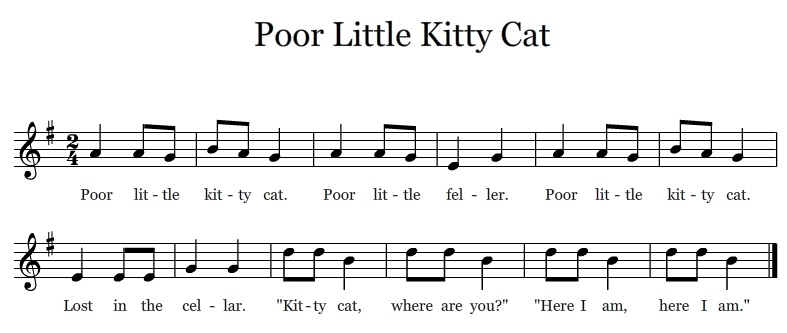
Then, the students sing the song "Juba" as we create a circle. Once in the circle, I sing the song "Poor Little Kitty Cat" while playing a soft chord bordun on an alto metallophone. My wonderful mentor, Carrianne, showed me this song when I was student-teaching with her. I've loved it ever since, but unfortunately I don't have the information for where to find the song, although I'm pretty sure it is in an Orff Level 1 book. The students sing and match the steady beat of my bordun with their hands. Then, I assign a student to hold "Juba" the cat and walk around the circle, lightly "bouncing" (not really touching) the stuffed cat above the student's heads on the beat (their bounce matches my playing). Whoever the cat lands on at the end of the song must respond to a sung question, "Kitty cat, where are you?" - "Here I am, here I am." This is a great time for me to praise students who are using a correct singing voice and encourage those who aren't. This also reinforces the steady beat. Often, I'll add students to an unpitched metal (I actually like jingle bells here, eek) on the steady beat.
We also re-visit these songs later in the year when we learn "Naughty Kitty Cat" which you can download for free here.
This is a song I created last year to review basic rhythms (quarter note/eighth note pair) with my 1st graders while also discussing melodic direction. It was very successful and this year I've re-vamped it with some more fun visuals. You can download it here (the instructions are included and they are very specific).
I love using fake fall leaves (available at Hobby Lobby - pretty much everywhere this time of year) as we sing and move to the song. We do several vocal exploration exercises (I move my leaf up and down and the students mirror with theirs, while singing "ooo" - then I give students a turn) before I perform the melody of the song for the students. As students learn the song, they are constantly moving to the melodic direction (using their leaves too). There are motions for each pitch and the students love this, but our favorite parts are the glissandos at the end.
In later lessons, we review the lyrics, track icons for the steady beat, track icons for the rhythms, learn the rhythms, and track icons for the melody. We also play the melody on boomwhackers (I change the color of the icons to match those of the boomwhackers). Students also re-construct the melody as a class using printables.
Melodic Icons
Melodic Icons for Boomwhackers
For the wrap-up lesson, students create their own "fall leaves" song which they share with the class then take home.
I've added some extensions to this file. Now, rhythmic icon and rhythm note cards are included. There are several suggestions in the file for ways to use them.
I've also included instructions to an vocal improvisation game that I'll share (the kiddos loved it):
Use this game after the first mini-lesson. You will need at least one fake fall leaf (I give each student one). Seat the students in the circle. Review the song. Tell students we will use an AB Form with A - singing and B - playing the game. Select a student to sit in the middle of the circle, place their leaf on their head, and shut their eyes. While singing the song, choose one student to take the leaf off the head of the child in the middle and hide it somewhere in the room. After the song, the student in the middle “wakes up” and begins to search around the room. The rest of the students guide that student to their leaf by: Shaking their leaf low and improvising on Do-Re (C major) by singing “ooh” - this indicates that the students is far away from their leaf. Shaking their leaf in the middle and improvising on Fa-So (C major) by singing “ooh” - this indicates that the students is heading in the correct direction Shaking their leaf up high and improvising on Ti-DO (C major) by singing “ooh” - this indicates that the student is very close to their leaf Once the student has found their leaf, the game can begin again. Extend this by having students improvise low, middle, and high sounds on C Major Pentatonic on a metallophone
This song is one of those that just "keeps on giving." I started using it as a piece to practice using our four voices, but eventually it evolved into teaching everything from adding instrumentation that connects to the text to solfa (mi so la).
In kindergarten, the students first learn the words as a speech piece. I used to use a poster to illustrate the song, but this year I used PowerPoint instead. I use the first few slides with the text and pictures to help students understand the lyrics of the song.
After that, the students add four voices to the lyrics. We talk about which parts match which voice (for example, "Crying at the locks" - we'd use our loud voice).
Next, we play a favorite little game. Students love the movement, and they love trying to "sneak" opening their eyes when "Willie" comes to get them. Usually, I reserve the role of "Willie" for myself, that way the students can't argue "But I had my eyes closed." Sometimes, I'll give the role to another student, or ask for "helpers" and they'll play with me. Either way, it is always a favorite.
For the next lesson, the kinder students add instrumentation based on connections to the text. This prepares them for doing so later with longer stories and books. It also exposes them to a variety of instruments that we'll use regularly in kinder.
We also discuss the steady beat of the song and keep it in a variety of ways while tracking the "door" icons:
This year, with my current first graders, we will extend the learning to include:
Rhythm Icons
Rhythm Symbols
Organizational Tools
The students will also add pitches to the song (which can be played on boomwhackers since it is in C major):
Melodic Icons - can use with younger students to prepare mi so la
Melodic Icons on the Staff
Melodic Icons with Solfa (off the staff is also included, along with slides for introducing la
correct rhythmic notation on the staff
All together now!
You can download the PowerPoint here. I've included lots of tips and suggestions for teaching in the "notes" section of most of the slides. I hope your kiddos enjoy this song too!
I've got "goal-setting" and "data tracking" on the brain. Lots of Leader in Me ideas floating around (big update on that coming soon).
I posted earlier about ways I intend to track student progress with my older kiddos. I created this activity for my younger ones. I haven't tried this one out yet - we'll see how it goes ;)
I want the kiddos to be "Star Rhythm Readers". I've seen a lot of sight-word activities where the students mark each word they know (have read for the teacher) with an X. I decided to adapt that idea for the music room.
Here's an example of a Star Rhythm Reader practice sheet.
Level 2 Example
There are three levels:
Level 1 - quarter note and eighth note pair
Level 2 - quarter note, quarter rest, eighth note pair
Level 3 - half note, quarter note, eighth note pair
I decided to add to the challenge by creating mini-levels:
Mini-level 1 - Chant rhythms - Students will chant the rhythms on syllables.
Mini-level 2 - Chant and clap rhythms - Students will chant the rhythms on syllables while clapping.
Mini-level 3 - Clap rhythms - Students will clap the rhythms without chanting the syllables.
Mini-level 4 - Chant and play rhythms - Students will chant the rhythms on syllables while playing on an instrument.
Mini-level 5 - Play rhythms - Students will play the rhythms on an instrument.
Students will set a goal by choosing a color to write their name on the paper (for example, writing your name in purple signifies that you want to get all the way to level 5).
Instructions for teachers are included:
I've also included a Student Achievement Tracking sheet. Next to the student's name, I'll color in each level they complete (red to purple). Here's a cute certificate to send home:
I also intend to send a copy of the rhythms home for extra practice. When a student completes the entire level, they will earn their picture on a special bulletin board and their name on the announcements. I'll be on the look-out for some sort of star sticker or token also (have you seen any?)
You can find this activity at my TPT store: Star Rhythm Reader. All pages are in Word so you may edit them (change patterns if you'd like). They are also included in PDF format.
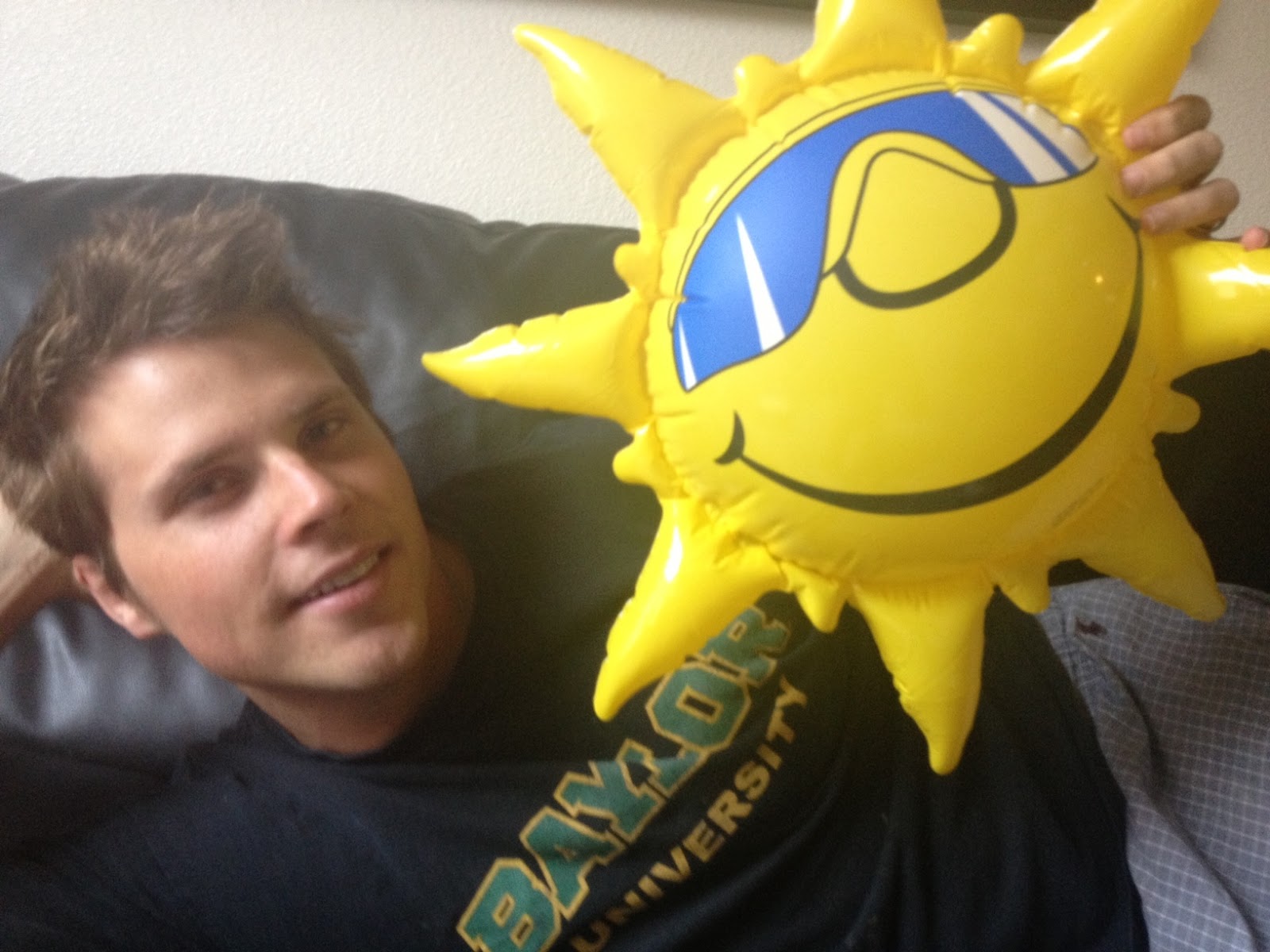
My husband came across this cute little sun at Dollar Tree. He said, "You could have the kids sing higher when the sun rises and lower when the sun sets." Clearly, he's been shopping with me so often that he knows what to look for.
Of course, Mr. Sun will come out when we sing and dance to "Mr. Sun" (Mister Sun, Sun, Mister Golden Sun, please shine down on me, etc). I used the song in a program two years ago and had costumes made (sun, tree, etc) so we always like to sing and act out that song. Here's the movements we use: Mister Sun, Sun, Mister Golden Sun: The "sun" walks out in front of the audience with three or four students trailing behind him/her. Please shine down on me: The sun stops and the students surround him/her, kneeling and pleading (hands clasped together). Oh Mister Sun, Sun, Mister Golden Sun: The sun walks backwards with the students following to the side of him/her. Hiding behind a tree: The sun walks behind the "tree". These little children are asking you to please come out so we can play with you: The students near the sun stand with their hands on their hips while the tree acts out singing these words. Oh Mister Sun, Sun, Mister Golden Sun: The "sun" walks out from behind the tree with the students trailing behind him/her. Please shine down on me: The sun stops and the students surround him/her, kneeling and pleading (hands clasped together).
The sun says, "OK"
As a partner song for that performance, I used "Sol, Solecito" an easy mi-so-la song in Spanish. There are some versions of the song on Youtube, but each one I checked out had horrid quality (singing, video, the whole bit). I'd suggest Googling it if you're not confident singing in Spanish for your own reference.
You can download the slides free on my TPT store, but I'd suggest reading through the post for more tips about teaching the song and incorporating a listening activity ;)
Kiddos can use this slide as a vocal exploration exercise (make sure they are singing Mi-So-La correctly in a key of your choice - C and D are used in the song) - they can sing on "sun" or a neutral syllable
Some students can even hold up the plastic sun in front of the others in the front of the room to lead the class.
Here are the lyrics of the song on the steady beat page (note - the English translation is not intended to be used, use the Spanish):
There's also a rhythm icon and rhythm slides.
The melodic icons look like this (plain). Try having the students tap their heads for "la", shoulders for "so" and tummies for "mi".
Melody Icons
Melody Icons without La
Melody Icons with La
Melody on Staff (C Major - lines)
Melody on Staff - D Major - Spaces
Once the song is learned, put the students in a circle. Someone in the middle can hold the sun (eyes closed, sun above their head) while the students walk around (holding hands) the circle. When the song ends, the person in the middle tosses the sun at the circle. Whoever is hit becomes the new sun.
A great piece to add a listening element to these sun songs is "Morning Song" from the William Tell Overture.
I don't know about your kiddos, but my little ones love listening exercises. 85% of them automatically start moving around without any direction from me (which is often times the goal as I'm observing them) but some look to me for direction/ideas/etc. Which is why, unless I'm doing a Dalcroze exercise or something specific where I don't want to help them, I usually structure listening exercises in this manner:
"Blind" Listening: Play a short (30 seconds or so) excerpt of the piece. Ask the students to describe it, tell you what it is about, make a connection (I heard this song when...). Often, I will ask them to listen for something specific (an instrument, a dynamic or tempo change, a "B" section, etc). It is so important to give them something to listen to in order to capture their attention and focus. Sometimes, I'll say, "What do you think I want you to listen for?" and play the piece (obviously after many listening examples) - what a great way to get kids listening critically. For this piece, I'll discuss the English Horn (which happens to be an instrument I can play and my favorite woodwind) and discuss the tempo of the song (with little ones, you may just be saying "slow" instead of discussing musical dynamic terms):
"Guided" Listening: I use a listening map, PowerPoint, rhythms taken from the song, structured non-locomotor movement or instrument activity, as we listen a second time - for this particular song: let students watch the following Youtube video to get their creative
juices flowing:
"Movement" Listening: I create, or have them create, or borrow from a textbook, resource, or video, a movement for students to use while they listen. For this song: Have the students create their own movement when you play
the piece again. I think this year I'll be the "sun" and carry around
our plastic friend while the other students follow behind as the
"clouds" carrying blue scarves. Students are creating their own movement but they have me and my movements for a frame or reference. Students should be moving slowly, with long, legato movements (sweeping arms, small twirls, etc).
"Critical" Listening: By now, the students have heard the piece multiple times and it is time for either an assessment or critical discussion. For this piece, I ask the students to identify what other instrument they hear "talking" with the English Horn (the flute). We discuss the different "timbres" of the instruments. We can even take a vote on which instrument students prefer (although English Horn usually wins for us, haha).
I hope you have a sunny time with these activities ;)
I know it is a little early, but while wandering Hobby Lobby yesterday, I came across this set of fall table scatter shapes for $3.99:
Although I'm sure they vary per package, mine included: 19 brown leaves, 31 green leaves, 13 red-brown acorns, 14 orange acorns, 8 golden acorns, and 7 green acorns.
I'm thinking of using them as a rhythm activity for 1st grade (although kinder could do this also, they just wouldn't dictate the rhythms).
Each pair of kiddos would get a copy sheet below (in a sheet protector with a dry erase marker and eraser) and a bag of acorns and leaves:
The students would create rhythm patterns with the shapes and say "a-corn" or "leaf" while clapping. Then, they would draw the correct rhythm and clap and chant on "ta" or "titi". Students could also dictate rhythms provided by the teacher or classmates. Rhythms could also be played on unpitched instruments.
Fun stuff - although I'm still not ready for school to start!

.JPG)


.png)
.png)
.png)
.png)


.png)
.png)


.png)
.png)
.png)
.png)
.png)
.png)
.png)
.png)
.png)
.png)
.png)
.png)
.png)
.png)
.png)
.bmp)
.bmp)
.bmp)
.png)

.png)
.png)
.png)
.png)
.png)
.png)

.bmp)
.bmp)