Showing posts with label Movement and Dancing. Show all posts

Sunday, October 19, 2014

On Her Broomstick

We all have those songs where we can't quite remember their source ("Wait, which book was this in?") and for me, this is totally one of those songs (feel free to comment if you know where it is from).  I've taught this song every year, usually with younger grades when we learn "Witch, Witch" although this year I'm going to try it with my older students as well.

Here's the tune:
The range is pretty large for younger kiddos but is still accessible.  I enjoy hearing  pretty "ooohs" from them.  We even discuss that this song is minor (when music is centered around "la" and sounds spooky, sad, or serious).  Older students can work on their 6/8 rhythms.

We use this slide to add instrumentation (please note that the glocks play E-B, E-B to match the pitch of the song).  It is important to have a lot of kiddos on instruments so that the movement (see instructions below) doesn't get too crazy.

I am currently learning the guitar - I mean, really, how have I not done this already?!  I'm nothing amazing AT ALL but I can play a few chords.  I am enjoying the freedom of moving the guitar wherever I need it (to our circle, on the floor, next to the rest of the instruments, etc) instead of being behind a piano.  Kiddos love singing with the guitar - there is something very "campfire sing-a-long" about it.  Here are the chords that I play.  If you have older students or just want to challenge some of your younger kiddos - they can play the chord root only (notice the circles around them match boomwhacker colors - hint hint ;) ).  You can discuss chords and accompaniment with older kiddos at this point as well.

Once we've established the song and the instrument accompaniment, it is time to add in the game.  My students are divided into four groups of about six kiddos, so this is usually how it goes:
Group 1: playing chord roots on Alto/Bass xylophones
Group 2: playing the metals (triangle, gong, glock)
Group 3: playing non-metals (quiro and hand drum)
Group 4: acting out the movement
When it comes time to switch, I just re-assign the groups to another job.  Easy!

Movement: The students are in scattered formation (they are the ghosts).  One student is the witch (complete with a hat and mini broomstick).   The witch flies around the ghosts for the first half of the song (the witch is on her broomstick flying very fast) the the ghosts join her in flying around on the second half of the song (ooo-oh, ooo-oh, Halloween is nigh).
No, this is not really a game, however, students usually understand that drama and music go hand in hand ("How strange would a movie be without music?" or "Doesn't music make you want to get up and move?").

Options (extend this song for another lesson - whoot!)
Add in a B section with the metals (Orff instruments tremolo on E, gong and triangle play freely but slowly) in which the witch chases and tries to tag the ghosts (this adds a game element - so fun).

Performance option: Older students can totally play the melody (you'd have to take the first B up the octave) on soprano xylo/metallophones (you only need a few that can play the melody - there are enough other parts for everyone else).  You could structure a form like this:
Introduction: Metal/Orff section instruments play (same as described above with optional B section) while ghosts and witch take their spots
A: Sing song with instrumentation and act out motions
B: Play song without singing or motions
A: Sing song with instrumentation and act out motions
Coda: same as intro, although tremolos slow and ghosts/witch fly out of performance space one by one

Monday, March 3, 2014

Captain, Go Sidetrack Your Train

Here's a rhythm activity I'm planning to use with my 5th graders (we're working on recorder and syncopa):


The students create their own rhythms and then improvise a melody on E-G-A-B on the recorder.  This creates a "B" section for the orffestration and movement we use with the song:


In this download at my TPT store, you'll find the printables you see above, lots of tempo vocabulary word printables, thorough slides for teaching the song, movement game instructions, full orffestrations, and 3 mini-lessons (with explicit instructions).  Check it out!

Sunday, September 15, 2013

Old Mrs. Witch

Ok, one of my favorite things to do during Halloween is dance around to "Flight of the Valkeries" (I'm sure Wagner is rolling in his grave).  Usually, we pretend to be bats or owls or something spooky that flies.  Everyone from Kinder - 5th loves this activity, but probably not as much as I do.  This is purely for fun, although older students can answer specific questions about the tempo, dynamic level, and instruments that they hear.

I only play the song for about 45-60 seconds.  We begin by unfolding our wings and stretching them out slowly.  Then, we flap our wings to mimic the movement of the strings.  Finally, when the brass enters with the main theme, we "take-off" and fly around.

I do a lot of crazy movement in my classroom, but the students are wonderful at following all the expectations (such as where we can fly and where we can't, how to avoid hurting others, the speeds and ways our bodys can move, what to do when the music stops, etc).  Define and set your parameters and you won't regret it.

This year, I think I'll pair the song (at least for my older students) with "Old Mrs. Witch" as we practice low la.  The slides for this song have now been added to my Fall into Music bundle.  I have included the slides here in case you'd like to use them.


I've also written orff parts for the metallophones and glocks - I love their sound with this song (that's only included in the bundle though).

Wednesday, September 11, 2013

The Owl and the Wind

It is no secret.  I love owls.  It really is a problem - but this little poem - well - I can't wait to incorporate it into my lessons.

I just created this, so we'll see how it goes (I'm thinking late September, early October with grades K-2).  We'll be able to discuss weather changes and what types of "signs" we see to know that the season has changed.  We can also discuss plenty or rhyming words.  You can also sneak in things like tempo (the leaves swirl quickly - they have a fast tempo) and dynamics (the wind howled loudly - it was forte). After enough experiences with these words, I can easily ask a 5 year old, "What was the dynamic level of that song?" and they can respond correctly.

Note: I'm really into using movement to help students understand text, lyrics, and vocabulary words.  We move all the time, even in 5th grade.  Having a movement helps students understand (especially with ELL's) what they are learning and can help them recall information.  Lots of teachers at my school do the same thing in ELA lessons with their students.  Most of the time, I let the students create the movement (with some guidelines).  For this, since I've already created the movement and the instrumentation we'll use, I'll ask the students to explain why they think I moved that way or why I added that specific instrument.  They enjoy figuring this out and following my creative thought process will help them with their own compositions later.

Here's the poem:
I've created a slide, movement, and instrumentation activity for each little phrase:

Movement: Students are standing, put hands out to sides and raise about mid-way (like wings).  Flap wings for “a little owl” then bend down (pretend to sit) on “sat on a branch”.
Instrumentation: Wood block (like the wood of the tree), plays, “Little owl, Little owl” (titi-ta, titi-ta)
Movement: Students hug themselves and shiver.
Instrumentation: Metallophones do a tremolo (any pitch is fine – I suggest setting up in c pentatonic).
  Movements: Students twirl, with hands rising from low to high, either in place or safely around the room.
Glockespeils: Glissandos up and down.
Movement: Students extend their arms out above their heads like the branches of the tree and sway back and forth.
Instrumentation: Either temple blocks or agogo bells (something with two distinct sounds) play “sway-ing-branch-es” (ta (higher pitch), ta (lower pitch), ta (higher pitch), ta (lower pitch))
Movement: Students cup hands around mouth as if “howling.”
Vocalization: All students sing “ooooh”, moving their voices up and down
Movement: Students put their hands up by their chests (like a begging puppy or the arms of a T-Rex) and scurry about the room.
Instrumentation: Rhythm sticks play “hur-ry, hur-ry, scur-ry, scur-ry” (titi, titi, titi, titi).
 Movement: Students look upward.
Instrumentation: Metallophones and glocks glissando up.
  Movement: Students spread out fingers in front of them and mimic snow falling.
Instrumentation: Jingle bells lightly shake.


I'll be updating my "Fall into Music" set with this and at least two other files this weekend.  Check it out ;)

Monday, September 9, 2013

Kitty Cat Lessons for Kinder

My kinders and I are having a fun time with kitty cat songs.  I have a cute little grey stuffed cat named Juba that the students love to sing a play with.  There is a little song called "Juba", but I'll have to add that later as the music is at school - whoops.


 We are big into "I can" statements this year, so:
1. I can use my singing voice when I sing with the class.
2. I can use my singing voice when I sing alone.
3. I can listen for quiet and loud sounds in a song.
4. I can listen for a fast steady beat and a slow steady beat in a song.
5. I can play the xylophone correctly on the steady beat.
6. I can play the jingle bells correctly on the steady beat.
7. I can use music to tell a story.
8. I can move and play in the music room safely.
Obviously, the kinders can't read all of these (you should see my first graders - they love to read them and "check them off" in their brains as we do them) but I still use this language with them.  I don't bombard them all at once with these statements, but rather refer to them as we need them through out the lessons.

To being the lesson, I teach the song, "Soft Kitty" by rote.  Yes, we are talking the same, "Soft Kitty" song that Sheldon sings in the TV series the Big Bang Theory (of which I am a huge fan).  We pantomime motions that correspond to the words and the students love it (my 1st graders still ask to sing this all the time).  Later in the year, we can decode the rhythm since it uses the ta, ta rest, and titi (see, it is still educational!).  The version I use is a little different from the one below (I have a quarter note and then a rest instead of the half note and I end this song with do-re-do instead of do-do-do).  We discuss the dynamic level of this song (quiet - piano).  The students sing this beautifully with nice tone - I love it:
Click on this to learn more about the song

Cute little picture to help explain the song
Then, we learn the story for "Old Grey Cat".  I show the students this visual as we listen to the song.  In the last verse, the tempo speeds up and the music gets louder (forte).  We discuss this change and why it fits with the song.  We also discuss using music to tell stories (which is great because I often incorporate books, short stories, poems, or story-songs into our lessons).


 Afterward, the students sing with the recording.  We do the following movements, all while singing.  I assign one student to be the "cat":
Verse 1: The cat pretends to be asleep, curled up on the floor.  The other students are the "mice" and they point at the cat as if noticing "oh, he's asleep, we can come out now"
Verse 2: Mice pretend to creep around (hands up by chest like, small tiptoe steps).
Verse 3: Mice pretend to eat cheese with hands.
Verse 4: Mice pretend to sleep, lie on back.
Verse 5: The cat wakes up and pretends to sneak around (on two legs, not four).
Verse 6: The mice wake up and safely run (it is really controlled jogging - we never run if we are inside) while the cat pretends to chase them.  On the words "in the house" the mice must freeze and put their hands in a point above their heads (like a house roof) before the cat can tag them.
There is really no point to this game.  If the cat tags someone, we pretend to "chomp" them, then they promptly return to the next repetition of the game.  The kiddos don't mind - they love it.  I switch out the cat every round.

To extend this, I assign a few students to soprano xylophones set up in G pentatonic.  The students can keep the beat with both hands playing together on any notes they choose.  During the last verse, the students enjoy playing with the quicker tempo.
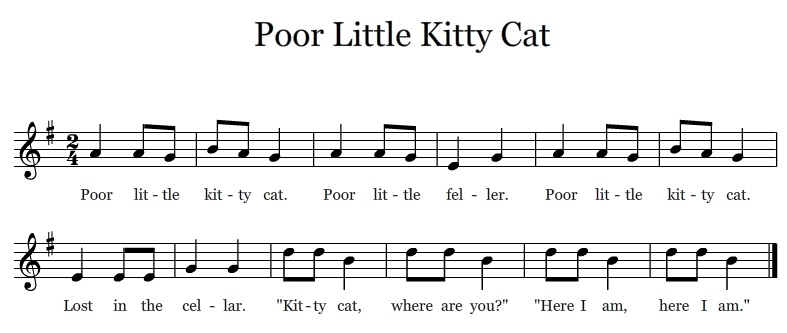
Then, the students sing the song "Juba" as we create a circle.  Once in the circle, I sing the song "Poor Little Kitty Cat" while playing a soft chord bordun on an alto metallophone.  My wonderful mentor, Carrianne, showed me this song when I was student-teaching with her.  I've loved it ever since, but unfortunately I don't have the information for where to find the song, although I'm pretty sure it is in an Orff Level 1 book.  The students sing and match the steady beat of my bordun with their hands.  Then, I assign a student to hold "Juba" the cat and walk around the circle, lightly "bouncing" (not really touching) the stuffed cat above the student's heads on the beat (their bounce matches my playing).  Whoever the cat lands on at the end of the song must respond to a sung question, "Kitty cat, where are you?"  - "Here I am, here I am."  This is a great time for me to praise students who are using a correct singing voice and encourage those who aren't.  This also reinforces the steady beat.  Often, I'll add students to an unpitched metal (I actually like jingle bells here, eek) on the steady beat.


We also re-visit these songs later in the year when we learn "Naughty Kitty Cat" which you can download for free here.

Sunday, September 1, 2013

Wee Willie Winkie


This song is one of those that just "keeps on giving."  I started using it as a piece to practice using our four voices, but eventually it evolved into teaching everything from adding instrumentation that connects to the text to solfa (mi so la).

In kindergarten, the students first learn the words as a speech piece.  I used to use a poster to illustrate the song, but this year I used PowerPoint instead.  I use the first few slides with the text and pictures to help students understand the lyrics of the song.
 After that, the students add four voices to the lyrics.  We talk about which parts match which voice (for example, "Crying at the locks" - we'd use our loud voice).

Next, we play a favorite little game.  Students love the movement, and they love trying to "sneak" opening their eyes when "Willie" comes to get them.  Usually, I reserve the role of "Willie" for myself, that way the students can't argue "But I had my eyes closed."  Sometimes, I'll give the role to another student, or ask for "helpers" and they'll play with me.  Either way, it is always a favorite.
For the next lesson, the kinder students add instrumentation based on connections to the text.  This prepares them for doing so later with longer stories and books.  It also exposes them to a variety of instruments that we'll use regularly in kinder.

We also discuss the steady beat of the song and keep it in a variety of ways while tracking the "door" icons:


This year, with my current first graders, we will extend the learning to include:
Rhythm Icons

Rhythm Symbols

Organizational Tools
The students will also add pitches to the song (which can be played on boomwhackers since it is in C major):
Melodic Icons - can use with younger students to prepare mi so la

Melodic Icons on the Staff


Melodic Icons with Solfa (off the staff is also included, along with slides for introducing la

correct rhythmic notation on the staff

All together now!
You can download the PowerPoint here.  I've included lots of tips and suggestions for teaching in the "notes" section of most of the slides.  I hope your kiddos enjoy this song too!

Monday, July 15, 2013

Dinah/Pick a Bale

I'm working on a few new lessons for my older kiddos (4th and 5th).  This lesson is a review for the beginning of the year.  The students learn "Dinah" by using reading skills and have fun with movement for "Pick a Bale of Cotton" (which they learn by rote at first but we will revisit it later as they learn "fa").

I love it because:
1. Vocabulary: We review TONS of vocabulary as we learn the song (vocabulary words are defined on nearly every slide)
2. Pitches: We review the pitches Do Re Mi So La to prepare for a review of high Do, low La, and low So
3. Rhythm: We review the half note, quarter note/rest, eighth note pair, and sixteenth notes (in prep for learning more 16th-note variations).
4. Instrumentation: I love transitioning from fun body percussion (including clapping, tapping shoulders, and patting) to a three-part Orff arrangement (BX/BM, AX/AM, and tambourine)
5. MOVEMENT: I created this movement myself inspired on a few "getting to know you" activities I did with my family at summer camp this year.  They did a version of "rock paper scissors" that even I loved.  I decided to adapt it to the song and give it a "farm" theme - we've got the "farmer", "wolf", and "bull".

Here are some slides from the PowerPoint:
Steady Beat

Adding organization

Rhythmic Icons

Prep for Tika-Tika

Rhythm Slide
Melody Prep Slide

Melody Prep on Staff

adding solfa pitches

solfa melody

solfa on staff

rhythms on staff

entire song - talk about phrasing

 Instrumentation and movement activity is included.  You can download the file here Dinah/Pick a Bale

I also like this line dance for the song "Pick a Bale":