In the past I've struggled with explaining "syncopa". I mean, sure the kids understand what to call it and they understand the short-long-short feeling of it, but do they really understand all the components and how they indeed last two beats? Yikes!
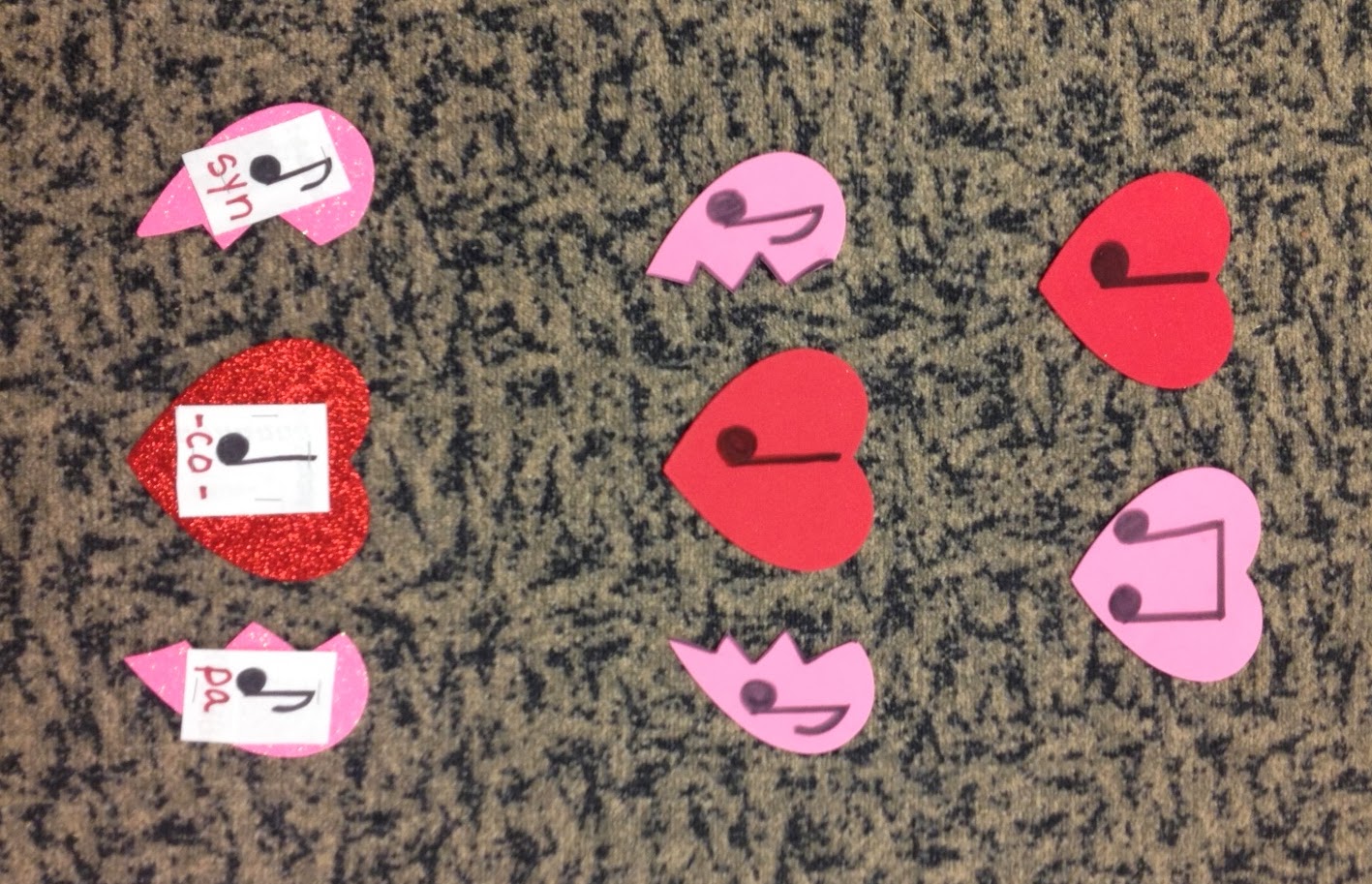
So, this is a silly way I've created to explain it (I can't get the picture to not go sideways, sorry! - and of course, being the Kodaly person I am, the students have already experienced the feel of syncopa, they were prepared, it just hadn't been presented yet):
First, I lay-out the quarter note heart and eighth note pair heart. I ask the students, "Which heart has one sound on a beat?" (quarter note) and "Which heart has two sounds on a beat?" (eighth note pair). "How many beats do you see now?" (two) and "How many sounds do we have?" (three) "Well, one day the quarter note was hanging out with his friends the eighth note pair. The eighth note pair always went somewhere together - they were best friends - BFFs. In fact, the quarter note had never seen them apart. Today, however, as he approached, he heard the eighth note pair arguing. It seemed they had grown tired of hanging out all the time and need a little break from each other. They were getting pretty upset (at this point I take out the pink heart with the eighth notes, separate or "break" it, and put the quarter note in between them), so the quarter note decided to get in the middle of their argument to try to help them out." Then I ask the students "How many beats do we see?" (two) "How many sounds do we see?" (three) "Where does the longest sound occur?" (in the middle) We chant it saying "ti-ta-ti" and do a pat-clap-pat body percussion with it. Then, I say "The quarter note helped the eighth note pair realize that they need a little bit of a break from each other. The three of them walked around in this order and decided that they liked this arrangement. Maybe they could stay this way and become something else all together?" (At this point I bring out the syn-co-pa hearts). "Look, its a new rhythm called syn-co-pa!" We chant syn-co-pa and use pat-clap-pat. Then I ask "How many beats make-up syncopa?" (two) "How many sounds make up syncopa?" (three) "Where do the short and long sounds occur?" (short-long-short). "How many eighth notes make up syn-co-pa?" (two) "How many quarter note are in syncopa?" (one)
I like to use syncopa around Valentine's day because of the heart analogy (the hearts are currently available at Target in the $1 section) and because there are so many cute Valentine's Day songs that use syncopa. I found this song at Amy Abbott's blog last year. Here's how I plan to have my students dictate the rhythm this year:
The students can see that "syn-co-pa" doesn't fall exactly on the beats like the quarter note and half note do.
My 3rd grade students are currently learning about fractions in their math classes. I thought that this might be a way to help them with this topic while teaching music. This would be really cute paired with "Pizza, Pizza Daddy-O".
In the past I had students create their own pizzas and I'm thinking they could do this also, but this time we'll cut out the slices and do some addition/subtraction problems together (such as - a half note plus a quarter note plus two eighth notes) to create rhythms to read and perform.
Students can also play the rhythms on orff instruments while other students move to them (they love this and I usually use tubano drums set up in a circle with the "dancers" in the middle):
Whole Note: step once and stretch out body
Half Note: hop twice
Quarter Note: walk four steps
Eighth Note: jog eight steps
Sixteenth Notes: tip-toe run for 16 steps (this is our favorite)
****A student could hold up a pizza so the others know what to move/play***
Lots of ideas swirling around but I would appreciate your suggestions on how to incorporate fractions. I've seen some cool ideas with legos too ;)
Since my 1st graders are super busy with the music for their Winter Program, this year my Kinders (yes, Kinders - they are doing so well) are working with Thanksgiving Rhythms (you can find this activity and other lessons and printables in this download from my TPT store):
First, we discuss each food you see below:
Then, we sit in a circle and chant (while keeping the steady beat): We will eat your dinner, Whatever you might pick, But we won't eat those monkey brains 'Cause that will make us sick!
We pass around a little stuffed turkey while we chant this. Whatever child the turkey lands on chooses a food, and then we figure out the rhythm that goes with the food. (The kiddos are pretty solid on "ta" and "titi", so now we're working on combining them into two or four beat phrases)
So:
Quarter Note: corn, bread
Eighth Note Pair: gravy, turkey
Eighth Note Pair and Quarter Note: casserole, pumpkin pie
Once we know what the rhythm of the food is, we turn it over and it is "eaten". The kiddos enjoy it and the whole activity doesn't take too long to complete.
With my 1st graders, we usually complete this worksheet:
I don't know about you, but cutting and pasting with kinders is just not something I want to do. To practice the rhythms this year, we're using Amy Abbott's wonderful set of "Thanksgiving Dinner Rhythms". The kinders are only using "corn" and "turkey" but they're having fun creating the rhythms. Then, we move them to high and low pitch levels (prepping for so and mi) and use our singing voice.
Don't get me wrong, I love those "Lady that Swallowed Everything" and I always use "Five Little Pumpkins", but this year I wanted a new little story to use with my 1st graders. I also found some super cute candy-corn erasers (see previous post) at Target and I can't wait to use those.
So, I created a poem called, "The Night the Candy Corns Escaped." I know the firsties will love to figure out what happens. We can also pantomine and dramatize the words which will help them get ready for their Winter Program in December. The 'refrain' of the poem also incorporates rhythms the first graders are working on, so we'll get music reading practice too.
Here's the slides (instructions and printables are included in my Fall into Music set, but you are more than welcome to use what you see here):
In a subsequent lesson, we'll extract the rhythmic content of the first refrain:
I also included some printables to use (a rhythm worksheet, cards for matching the iconic representation to the real rhythm symbols) including this jar dictation sheet (we will use our erasers on this):
Here are a few pictures of the printables/manipulatives in action. I use sheet protectors and dry erase markers for student work all the time - I can easily assess the students without having to run off a bunch of worksheet copies. Students enjoy working with dry erase markers as well, so it is a win-win. For this activity, both pages are placed in the plastic sheet, as well as a marker, a piece of black felt for an eraser, and a bag of candy-corn erasers (again, those are from Target - $1 for 50 erasers).
I'm a huge fan of the Target dollar section and their seasonal stuff. Over the past three years, I've collected some great manipulatives that I love to use. I've already checked them out this year and I found the plastic pumpkins, plastic leaves, pumpkin erasers, and ghost erasers that you'll see below. I hope you find some great ideas:
Here's a cute little anchor chart the students can make (I've done these with 5th grade in the past, but that was when I had 45 minutes per class). The leaves are die-cuts made from construction paper.
Another fun activity (the small ghost erasers I found last year but the larger ones are currently at Target) is Mrs. White. I use this with K and 1 grades. It goes along with the poem:
Mrs. White had a fright
In the middle of the night
Saw a ghost eating toast
Halfway up the lamp post
Sorry - for some reason it wont go vertical - stretch your neck ;)
Introduction: We speak the poem and dramatize the words.
For Kinder - Beat vs. Rhythm Lesson
1. We count the beats (number of squares - 16 beats)
2. We point to the beats as we say the poem
3. We say, "short-short" on the two ghosts and "long" on the one ghost - that's the rhythm
4. We clap the rhythm (two claps for two ghosts, one clap for one ghost) first without the poem, then with the poem
5. The students add the large ghost erasers to the single ghost and the small ghost erasers to the paired ghosts.
For First - Quarter Note (ta) and Eighth Note Pair (titi) Lesson
1. We count the beats (number of squares - 16 beats)
2. We point to the beats as we say the poem.
3. We say "short-short" on the two ghosts and "long" on the one ghost - that's the rhythm
4. We clap the rhythm (two claps for two ghosts, one clap for one ghost) first without the poem, then with the poem
5. We add rhythm sticks to the rhythm as we say the poem and follow the ghosts
6. I laminate the worksheet and give the students a dry erase marker -
at the bottom, next to the picture of the one ghost, we draw a quarter
note (ta - one sound on one beat) and next to the picture of the two
ghosts, we draw an 8th note pair (titi - two sounds on one beat)
7. Using this key, the students draw the correct rhythm over each ghost picture - then we check our answers
This year, I found these acorns and leaves at Hobby Lobby ($3 a bag) and the pumpkins and more leaves at Target ($1 a box).
You can find my instructions for this activity here: Fall Rhythm Fun
The pumpkins are eighth note pairs (pumpkin) and the leaves are quarter notes (leaf).
This year when I incorporate my Leaves lesson, I'll have the students dictate the rhythm themselves.
Here's an example
The plastic figures match the rhythm icons I use in the song.
This year, I'm going to try to use these ice-cube trays. First, the students can create rhythm patterns. Then, they can use the top row as "so" and the bottom as "mi".
My 2nd graders are reviewing rhythmic structures. Their's will be a little more complex (I use the folders like this all the time, sometimes with cards, sometimes with manipulatives, etc):
This rhythm activity I used with the upper grades last year as a review. The students like to dictate patterns I sing or play, create their own patterns for the class to dictate, and play rhythms I have and create patterns to play. (You can find more about this here: Halloween Rhythm Dictations).
I used this activity with the song, "Pick a Pumpkin". The students decode the first two measures using their erasers (jack-o-lantern, black cat, black cat, skull).
You can find Mrs. White and the Fall rhythm fun printable here: Fall into Music
I've got "goal-setting" and "data tracking" on the brain. Lots of Leader in Me ideas floating around (big update on that coming soon).
I posted earlier about ways I intend to track student progress with my older kiddos. I created this activity for my younger ones. I haven't tried this one out yet - we'll see how it goes ;)
I want the kiddos to be "Star Rhythm Readers". I've seen a lot of sight-word activities where the students mark each word they know (have read for the teacher) with an X. I decided to adapt that idea for the music room.
Here's an example of a Star Rhythm Reader practice sheet.
Level 2 Example
There are three levels:
Level 1 - quarter note and eighth note pair
Level 2 - quarter note, quarter rest, eighth note pair
Level 3 - half note, quarter note, eighth note pair
I decided to add to the challenge by creating mini-levels:
Mini-level 1 - Chant rhythms - Students will chant the rhythms on syllables.
Mini-level 2 - Chant and clap rhythms - Students will chant the rhythms on syllables while clapping.
Mini-level 3 - Clap rhythms - Students will clap the rhythms without chanting the syllables.
Mini-level 4 - Chant and play rhythms - Students will chant the rhythms on syllables while playing on an instrument.
Mini-level 5 - Play rhythms - Students will play the rhythms on an instrument.
Students will set a goal by choosing a color to write their name on the paper (for example, writing your name in purple signifies that you want to get all the way to level 5).
Instructions for teachers are included:
I've also included a Student Achievement Tracking sheet. Next to the student's name, I'll color in each level they complete (red to purple). Here's a cute certificate to send home:
I also intend to send a copy of the rhythms home for extra practice. When a student completes the entire level, they will earn their picture on a special bulletin board and their name on the announcements. I'll be on the look-out for some sort of star sticker or token also (have you seen any?)
You can find this activity at my TPT store: Star Rhythm Reader. All pages are in Word so you may edit them (change patterns if you'd like). They are also included in PDF format.
I know it is a little early, but while wandering Hobby Lobby yesterday, I came across this set of fall table scatter shapes for $3.99:
Although I'm sure they vary per package, mine included: 19 brown leaves, 31 green leaves, 13 red-brown acorns, 14 orange acorns, 8 golden acorns, and 7 green acorns.
I'm thinking of using them as a rhythm activity for 1st grade (although kinder could do this also, they just wouldn't dictate the rhythms).
Each pair of kiddos would get a copy sheet below (in a sheet protector with a dry erase marker and eraser) and a bag of acorns and leaves:
The students would create rhythm patterns with the shapes and say "a-corn" or "leaf" while clapping. Then, they would draw the correct rhythm and clap and chant on "ta" or "titi". Students could also dictate rhythms provided by the teacher or classmates. Rhythms could also be played on unpitched instruments.
Fun stuff - although I'm still not ready for school to start!
It is amazing what can be found in the dollar bins at Target. I found this gem, "Old Maid" which I easily adapted into a rhythm game.
I'll play this game with my new 3rd graders as a review in the Fall. Some of the words on the cards can be tricky, so I'd say you'd be most successful playing this game with 2nd or 3rd graders.
The good thing about this activity is that there are many ways (probably more than I've listed) to incorporate other subjects into this musical review lesson.
Materials: Old Maid card game (laminate for durability), black permanent marker, rhythm instrument (optional), pencil and paper for writing response (optional)
Here is a picture of the all the cards with the rhythms I assigned them. Depending on the level of difficulty, you could incorporate some 16th note patterns.
Basic Game Directions Object: The players collect as many matching pairs as possible and avoid ending up with the Old Maid card. Set-Up: Put students into groups of 4 (or less). Shuffle and deal out all the cards. If a player has any matching pairs in their deck, they place them in their own discard pile. Gameplay: Players take turns picking a card from the hand of the player on their left. If a match is made, they put it in their discard pile. The game continues until only one player is left holding the card - the Old Maid card! They loose the game. Variation: The player with the Old Maid at the end wins - and gets her "cookies" (pictured on her card).
Musical Extensions
1. Students must clap and chant the rhythm on each pair they create. Then, the group can clap and chant that student's rhythm.
2. Students can lay out their pairs when finished and clap and chant each pair. They can play their pairs on an unpitched rhythm instrument.
Language Arts Extensions
1. After the game is played, students place the cards face up, paired, in alphabetical order (as in the picture above). They then take turns reading the cards. You can also discuss the use of alliteration ("fashionable fox" - both start with f's).
2. Students can create their own card (you can use small index cards) by first creating a name ("Silly Swan" or "Tricky Turkey" etc) using an adjective and an animal name. Then, they can illustrate the animal. Finally, they can write the rhythms that correspond to their animal. This way, you can create a student-made set to play with in the future. I CAN'T WAIT TO DO THIS!
3. Have students respond (with paper and pencil) to the following writing prompt, "Which character would you most like to meet? What would you talk about?" (you can also create your own prompts) Math Extension
1. Students can create a "bar graph" by graphing matching rhythms (see below). They can then discuss which rhythms had the most pairs, which had the fewest, and discuss the difference between them, add them together, subtract them, etc. (You could easily create a worksheet for them to log their answers, or put discussion questions on the board, such as "Which rhythm has second most pairs?")
I'm just warning you now, this post is rather lengthy. There are many videos and links to follow - and once you click on them, you might be drifting around in cyberspace, looking at some great resources for awhile. Consider yourself prepared ;)
I've been a fan of creating movement for Schumann's "The Wild Horseman" and Rossini's "William Tell Overture" with my younger grade for awhile. Students love these pieces and they are a great way to incorporate some Dalcroze concepts.
This year, I'm incorporating some music-reading as well, using the song "Bell Horses". It isn't difficult for students to make the connection between all three pieces.
Basically, this is a mini-unit of about three to four lessons (which is about 1.5 to 2 weeks for me). I like to open the class with our usual warm-up (includes movement, our "hello song" which I change periodically throughout the year, rhythm and melodic listening, decoding, and echoing exercises, and vocal exploration and breathing). I then like to review the relationship between Mi-So-La, using my floor staff. The students love moving them around the staff, and then I can use them as a large pitch-ladder (I'll point while I sing and have students match with handsigns, then I'll simply point and the students must sing). Sometimes, I won't sing on the solfa pitches or I'll bring out an instrument and do some ear-training - the students have to label what was sung or played using solfa pitches. For some students, they have the confidence to label and compose with mi-so-la, but they lack the confidence to truly sing them correctly without any assistance (they don't fully understand their aural relationships). Taking time at the beginning of class to have these experiences, as well as weaving them into lessons and games later on, help students truly become sight-singers, and not just sight-readers.
Ok, on to the "meat" of the lessons. Mini-lesson one opens with a discussion about Robert Schumann. I project his biography from Classics for Kids which we read and discuss. Remember that these are 1st or 2nd graders, so the reading and discussion incorporates one paragraph at a time. I have students hypothesize how events in the composer's life or background information might affect their music. Then, I have the students listen to the piece. If you are gifted with piano skills, you can download the song here: Wild Horseman Sheet Music and perform it for your class. If not, try this youtube video:
Here's the listening/movement plan I have them follow:
1. Listen - describe and discuss with a partner, then as a class (3-4 comments/questions)
2. Listen while patting steady beat - point out minor and major sections (which sound happy? which sound sad?) - if you are watching the video, you can discuss how the hands switch roles (the right starts playing the minor melody while the left accompanies, then the left plays the major melody while the right accompanies)
3. Listen while patting the steady with puppeteer hands (limp wrists) moving to show the melodic contour of the song (moving up and down) and also dynamic level (larger movements for forte, smaller for piano) - discuss what you saw them doing
4. Listen while moving around the room (walking feet only) - students should make larger and smaller movements, or move at higher or lower levels - DO NOT do this with them, see what they can create - then discuss why they moved in certain ways
5. Repeat step four (some students needed to see others do this and have a discussion before they are comfortable truly expressing the music) - tell students that it is ok now to add in more "horselike" movement (so much fun)
Tell students that they will now learn to read song that talks about mechanical horses. You can get the powerpoint at my TPT store: Bell Horses
For the first mini-lesson, guide your students through the first 8 slides (lyrics to rhythm). They will learn about bell horses and carillons. Try this video out (it is lengthy, I only show a bit):
Here's the intro slide:
And the lyrics slide:
And the steady beat slide:
I've also included a steady beat chart which you can print out for students to use individually:
There's also a slide for adding the time signature, barlines, and measures, a rhythm icon slide and a rhythm icon printable:
And finally the rhythm prep then rhythm page:
That's it for the first mini-lesson. To extend it, you can add body percussion to each rhythm or add some students performing the steady beat (either with their bodies or an instrument) while others perform the rhythm (again, either with their bodies or an instrument).
For the second mini-lesson, I begin with this biography of Rossini which we read and discuss. I love the lessons that Dr. Kay Edwards provides at Classics for Kids (click the link and then download the K-2 lesson) which include the William Tell Overture: Finale. It is VERY extensive and will require lots of prep and reading time on your part. Should you need the recording, you can find it on Classics for Kids or on Youtube (I like to show my students the live performance - how exciting - then use the classics recording for the listening map and movement):
You can also discuss the plot of the story (this is also a good time to discuss words such as "opera" and "overture":
After discussing the story and listening to the piece, I distribute this listening map (also from Classics for Kids) which the students follow while we listen.
We discuss the dynamics, tempo, and style of the music. We also discuss how it fits into the story. Most importantly, we discuss ways to keep the beat it. We try various ways to keep the beat while listening. (Further instructions are included in Dr. Edward's lessons). Then, I have the students stand up and we try these movements around the room (SO MUCH FUN - if a little silly):
Introduction: prepare our horses to ride (check hat, check shoes, etc)
A: 2 sets of 16 counts: Gallop around the room in a circle - for the ascending leap in the melody (beat 13), we pretend to leap over a hurdle (repeat)
B:Pretend to prance around quickly, while waving hands above head to show the shape of the melody - Beats 1 and 2 - hands up and over to the left, Beats 3 and 4 - hands up and over to the right, Beat 5 to the left, Beat 6 to the right, Beat 7 to the left, Beat 8 to the right (repeat 4 times) - during transition, we get our horses ready
A: repeat as above
To add variety for repetitions: If you have scarves, I love to use those in the A section as our reins and then in the B section we wave them above our heads like flags. If you've made those cute Funoodle horses, those are great too. I only have a hobby horse that I'll let the students take turns using.
Close this section by: Reviewing the composer, reviewing vocabulary, reviewing what we did and why, reviewing descriptions of the music, etc.
After our listening and movement fun, I seat the students and give them this worksheet:
The students have to fill in the correct rhythms for the song "Bell Horses" - this is a great way to review their learning from the previous lesson and transition into teaching the melody. After we've completed and checked their work (using slide 8 from the powerpoint), I move into teaching the melody. Here are some slides for that.
Melody Prep Slides:
Then adding solfa (prepare for La):
Then we sing the song with la added:
We put our pitches on the staff:
Add in our correct notation:
Then look at the whole song:
If time allows, we'll add in movement and orff, but usually I save that for Mini-Lesson 3.
For mini lesson 3, we begin in a circle. I pass a bag that includes Bell Horse lyric cards, rhythm cards, and solfa cards. Here's and example and how we use them:
Rhythm Cards
After using the printables, I add in a simple orffestration which is included in the download. Then, we do some creative movement:
Afterward, we review the pieces we've moved to previously, then move to them once more, after having a discussion about what we could add or change.
Note: This download will also be included in a new set of Mi So La lessons.



.png)


.png)
.png)

.png)


.bmp)
.bmp)
.bmp)

.bmp)
.bmp)


.png)
