Showing posts with label Spanish Songs. Show all posts

Monday, July 8, 2013

Sol, Solecito

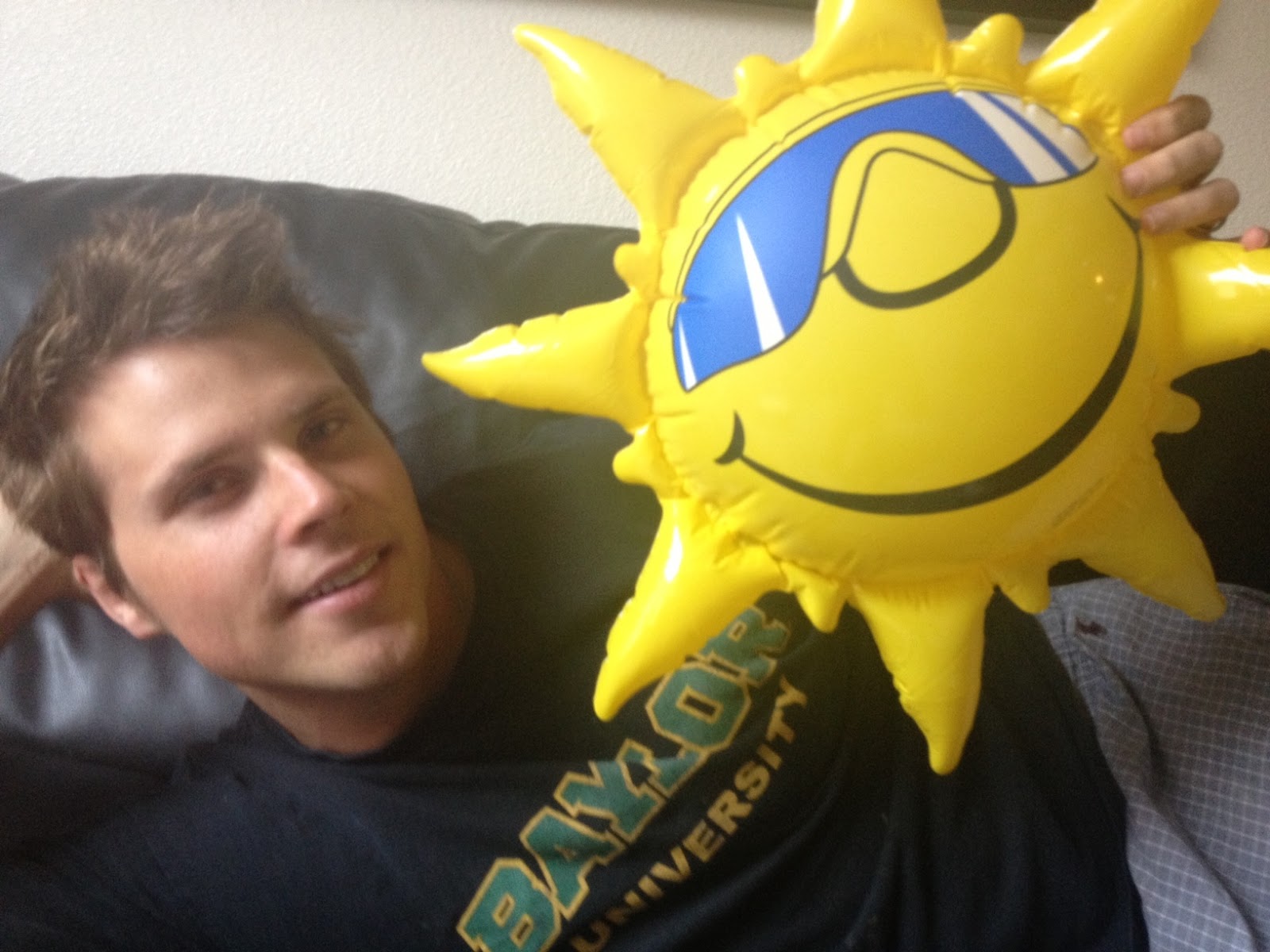
My husband came across this cute little sun at Dollar Tree.  He said, "You could have the kids sing higher when the sun rises and lower when the sun sets."  Clearly, he's been shopping with me so often that he knows what to look for.

Of course, Mr. Sun will come out when we sing and dance to "Mr. Sun" (Mister Sun, Sun, Mister Golden Sun, please shine down on me, etc).  I used the song in a program two years ago and had costumes made (sun, tree, etc) so we always like to sing and act out that song.  Here's the movements we use:
Mister Sun, Sun, Mister Golden Sun: The "sun" walks out in front of the audience with three or four students trailing behind him/her.
Please shine down on me: The sun stops and the students surround him/her, kneeling and pleading (hands clasped together).
Oh Mister Sun, Sun, Mister Golden Sun: The sun walks backwards with the students following to the side of him/her.
Hiding behind a tree: The sun walks behind the "tree".
These little children are asking you to please come out so we can play with you: The students near the sun stand with their hands on their hips while the tree acts out singing these words.
Oh Mister Sun, Sun, Mister Golden Sun: The "sun" walks out from behind the tree  with the students trailing behind him/her.
Please shine down on me: The sun stops and the students surround him/her, kneeling and pleading (hands clasped together).
The sun says, "OK"


As a partner song for that performance, I used "Sol, Solecito" an easy mi-so-la song in Spanish.  There are some versions of the song on Youtube, but each one I checked out had horrid quality (singing, video, the whole bit).  I'd suggest Googling it if you're not confident singing in Spanish for your own reference.

You can download the slides free on my TPT store, but I'd suggest reading through the post for more tips about teaching the song and incorporating a listening activity ;)

Kiddos can use this slide as a vocal exploration exercise (make sure they are singing Mi-So-La correctly in a key of your choice - C and D are used in the song) - they can sing on "sun" or a neutral syllable
Some students can even hold up the plastic sun in front of the others in the front of the room to lead the class.

Here are the lyrics of the song on the steady beat page (note - the English translation is not intended to be used, use the Spanish):
There's also a rhythm icon and rhythm slides.

The melodic icons look like this (plain).  Try having the students tap their heads for "la", shoulders for "so" and tummies for "mi".
Melody Icons

Melody Icons without La

Melody Icons with La

Melody on Staff (C Major - lines)

Melody on Staff - D Major - Spaces
Once the song is learned, put the students in a circle.  Someone in the middle can hold the sun (eyes closed, sun above their head) while the students walk around (holding hands) the circle.  When the song ends, the person in the middle tosses the sun at the circle.  Whoever is hit becomes the new sun.

A great piece to add a listening element to these sun songs is "Morning Song" from the William Tell Overture. 

I don't know about your kiddos, but my little ones love listening exercises.  85% of them automatically start moving around without any direction from me (which is often times the goal as I'm observing them) but some look to me for direction/ideas/etc.  Which is why, unless I'm doing a Dalcroze exercise or something specific where I don't want to help them, I usually structure listening exercises in this manner:

"Blind" Listening: Play a short (30 seconds or so) excerpt of the piece.  Ask the students to describe it, tell you what it is about, make a connection (I heard this song when...).  Often, I will ask them to listen for something specific (an instrument, a dynamic or tempo change, a "B" section, etc).  It is so important to give them something to listen to in order to capture their attention and focus.  Sometimes, I'll say, "What do you think I want you to listen for?" and play the piece (obviously after many listening examples) - what a great way to get kids listening critically.  For this piece, I'll discuss the English Horn (which happens to be an instrument I can play and my favorite woodwind) and discuss the tempo of the song (with little ones, you may just be saying "slow" instead of discussing musical dynamic terms):


"Guided" Listening: I use a listening map, PowerPoint, rhythms taken from the song, structured non-locomotor movement or instrument activity, as we listen a second time - for this particular song: let students watch the following Youtube video to get their creative juices flowing:


"Movement" Listening: I create, or have them create, or borrow from a textbook, resource, or video, a movement for students to use while they listen.  For this song: Have the students create their own movement when you play the piece again.  I think this year I'll be the "sun" and carry around our plastic friend while the other students follow behind as the "clouds" carrying blue scarves.  Students are creating their own movement but they have me and my movements for a frame or reference.  Students should be moving slowly, with long, legato movements (sweeping arms, small twirls, etc).

"Critical" Listening: By now, the students have heard the piece multiple times and it is time for either an assessment or critical discussion.  For this piece, I ask the students to identify what other instrument they hear "talking" with the English Horn (the flute).  We discuss the different "timbres" of the instruments.  We can even take a vote on which instrument students prefer (although English Horn usually wins for us, haha).

I hope you have a sunny time with these activities ;)

Sunday, May 12, 2013

Matarile

This song is fun and easy to sing in both Spanish and English.  My 2nd graders are working on solidifying our work with "Re" and this is also a great song to practice that concept.  It is also an easy way for students to use common action verbs in both languages (and to discuss what action verbs are).

To begin, get students thinking about ways they can move.  This can be as simple as brainstorming a list and then having the students move to words on the list for 8 beats (for example, run in place for eight beats).  Students can take turns writing words on the board, leading the class in creating the motions, or playing the eight steady beats on rhythm instruments.  If you have a bilingual class or you also intend for your students to sing the song in Spanish, have them brainstorm Spanish action verbs and then write the English translation next to them.

Student can then learn the notation of the song using the Matarile powerpoint:

This slide can be used a pitch ladder and can be used in many ways:
1. Sing a pattern while pointing to the butterflies - students echo the pattern
2. Point to the butterflies (in a short pattern) and have students sing the pattern back to you
3. Play a pattern on an instrument and have students sing the pattern back to you (one student can go and point to the butterflies)
4. Have students create patterns using the butterflies for their classmates to sing

Note: I used butterflies because they reminded me of the spanish word for butterflies, "mariposa" which also starts with "m".  "Matarile" is a non-sense name in Spanish, so I like to say that Matarile is a mariposa.
 
I created the PowerPoint in English (although there is a spanish translation slide - see below) because the actual rhythm that would match with "quiere us" of "que quiere usted" would be tika-ti (two sixteenths and an eighth) which my 2nd graders haven't learned yet.
I like to add the steady beat while also adding the claves.  If you have a butterfly net (which I do - thanks to the Target $1 bin), you can have the students go up to the screen and "catch" each butterfly by pointing to them while the class chants the words.  Then, we organize the music:
Students can also use the butterfly net as a pointer and go point to each symbol.

Next is the rhythm preparation slide.  On the pair of butterflies, the students say, "but-ter" and on the single butterfly, they say, "fly".  Then, they track the pictures while saying the correct words.
Students love to predict which rhythms will appear based upon the pictures above.  Usually, I'll have them make the predictions in their head, then "check their work" when I reveal the next slide.  They say, "Yes!  That's exactly what I thought I would see!"
Students can then chant the rhythm then the correct text.  I like to play the claves on the steady beat while they play the rhythm on rhythm sticks.  We can discuss the difference in timbre between two similar-looking instruments.  I then tell the students to match the claves with their feet while their hands match the rhythm sticks (select a few students to keep playing).  This is a mini "beat vs. rhythm" reinforcement opportunity.

Afterward, I like to pass out my scarves to the students.  I ask them to "float" their scarves through the air and sing on a soft "loo".  We talk about the melodic direction and how our voices can follow the scarves up and down.  I select students to come to the front and lead us with their scarf - we follow what they do while singing.  Sometimes the students like to "float" all over the room while singing and moving their scarf.  However, if their scarf floats too high or too low, I think this year I'll snatch it with my butterfly net.

Then, students can learn the correct solfa of the song:


Eventually leading up to the full notation:

Then, incorporate the motions that students brainstormed earlier to complete the movement activity:


Sunday, April 21, 2013

Mi So La Lesson Bundle 2

I'm still adding to this file, Mi So La Lesson Bundle as I come up with more things for my own kiddos.  It is my second bundle of Mi So La lessons and is great for late 1st or early 2nd (depending on where your students are musically).

The file is pretty extensive and took a lot of work.  However, I did include a free download of "Plainsies Clapsies" in the preview - you can at least check that out, enjoy it, and see if the format works for you.

This Zip file includes:

C Major Songs and Activities:
1. Plainsies, Clapsies - 26 slides for learning the song, including instructions, movement, and instrumentation, printable Steady Beat page, printable Rhythm Icon page, Printable Melodic Direction page, printable rhythm worksheet, printable lyric, rhythm, and melody cards for assessment

2. Little Ruby Red Bird - 34 slides for learning the song, including instructions, movement, and instrumentation, printable Steady Beat page, printable Rhythm Icon page, Printable Melodic Direction page, printable rhythm worksheet, printable lyric, rhythm, and melody cards for assessment

3. Birdy Bounce - melodic matching game with instructions for four ways of game-play

4. 24 Robbers - 61 slides for learning the song, including instructions, movement, and instrumentation

5. Mi So La Mad Minute in C Major - use for pre-assessment, practice, or assessment
6. Mi So La Folder Game in C Major - for small-group use and practicing

D Major Songs and Activities:
1. ¡Adivina lo que es! - 34 slides for learning the song, including instructions, printable Steady Beat page, printable Rhythm Icon page, Printable Melodic Direction page, printable rhythm worksheet, printable lyric, rhythm, and melody cards for assessment

2. Bell Horses - 36 slides for learning the song, including instructions, movement, and instrumentation, printable Steady Beat page, printable Rhythm Icon page, Printable Melodic Direction page, printable rhythm worksheet, printable lyric, rhythm, and melody cards for assessment

3. Mi So La Mad Minute in D Major - use for pre-assessment, practice, or assessment
4. Mi So La Folder Game in D Major - for small-group use and practicing


Tuesday, April 2, 2013

Ballet of the Unhatched Chicks/Los Pollitos

It really, really, was NOT COOL that we had Spring Break the week before Easter.  So, I'm still kinda wrapping up some bunny and chick stuff.  Oh well :)

Earlier in March, I posted this post about some "fowl" (not foul) activities to use in the Spring with your younger kiddos.

Here's another bird-related lesson plan, which you can download here, for cheep.  So cheep, it is free!  I'd suggest using some of it (the listening map, movements, rhythms of "los pollitos") with K and 1, but 2nd and 3rd should be able to understand and enjoy all of it.  However, I gave my Kinder quite the spiel on Tchaikovsky (he is my FAVORITE) over Christmas and they still recall much of it - so I'll subject them to the composer, background, and vocabulary information also.

It is based on the "Ballet of the Unhatched Chicks" from Pictures at an Exhibition by Modest Mussorgsky.  It also includes the popular Latin folk song, "Los Pollitos".

I didn't include a copy of "Ballet" - but you can easily download it from iTunes or find it on Youtube.  This video is pretty - interesting:

There are 21 slides total (22 if you count the first, "Thank-you for downloading, you're awesome" note from me).

Here's the composer background info (I've also included info about the piece itself and a slide with vocabulary):

And here's an example from the listening map (B section):
The slide also includes movement instructions and a discussion slide.  Here's some of the slides from "Los Pollitos".  Don't worry, thorough instructions are included in the notes section of the PowerPoint.


Note: The dance moves - oh my, they are hilarious.  However, you'll need to go slower and model them, especially if the students are younger.  I do lots of funky little movements with my kiddos, and here's a tip for "controlling the crazy".

I say, "Power-off" (so-so-mi) and the students look like powered off robots, silent robots, with their heads bowed, legs still, and hands at their sides.

Then, I'll say, "Power-on" (mi-mi-so) and the students remain in the same position, only, they raise their heads, look at me, and get ready for information/the next step.

It works like a charm.  I'll also sing "Please stand up (do-mi-so)" and "Please sit down (so-mi-do)" while motioning up or down.

Have fun!