Sunday, July 7, 2013

Fall Rhythm Fun

I know it is a little early, but while wandering Hobby Lobby yesterday, I came across this set of fall table scatter shapes for $3.99:

Although I'm sure they vary per package, mine included: 19 brown leaves, 31 green leaves, 13 red-brown acorns, 14 orange acorns, 8 golden acorns, and 7 green acorns.

I'm thinking of using them as a rhythm activity for 1st grade (although kinder could do this also, they just wouldn't dictate the rhythms).

Each pair of kiddos would get a copy sheet below (in a sheet protector with a dry erase marker and eraser) and a bag of acorns and leaves:
The students would create rhythm patterns with the shapes and say "a-corn" or "leaf" while clapping.  Then, they would draw the correct rhythm and clap and chant on "ta" or "titi".  Students could also dictate rhythms provided by the teacher or classmates.  Rhythms could also be played on unpitched instruments.

Fun stuff - although I'm still not ready for school to start!

Apple Tree


Although this song uses the pitches Do-Mi-So-La, I think it is a great song to use with 3rd graders at the beginning of the year (apples are so fall/school themed anyway) as we review all the pitches they learned in 2nd.  I begin using songs with Do-Re-Mi, then add So and La in a variety of ways until the Do Pentatonic scale has been reconstructed (this "review" usually takes the first 1.5 months of school).  I've added lots of little "extras" to this download, check it out:
Lyrics Slide
Steady Beat Slide
Rhythm Icon Slide
Rhythm Slide
Rhythm Worksheet
The slide above can be used (after printed on cardstock, laminated, and placed in plastic bags) as a dictation exercise (students can dictate patterns of your choice or use the icons to recreate the rhythms of the song) or composition exercise (students can create patterns of their own for others to dictate, play on an instrument, or use as an ostinato).
Add the Melody

Melodic Icons
You'll notice that "Re" is included in some of the following slides because my students have already learned it at this point.  If you're using this song with 2nd graders, skip over those slides.

Solfa Icons


Solfa on Staff


Melody on Staff


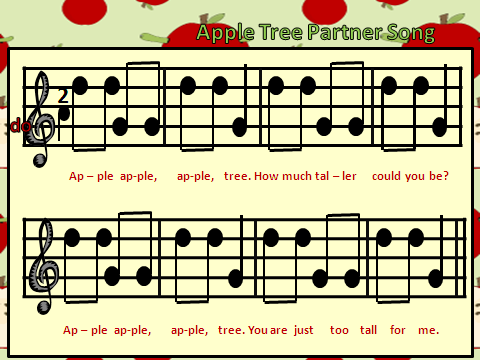
For some extra fun, I added a partner song this year (created by me).  Instructions are included for transferring the song to bass xylophones and also for creating two-part singing music with your students.

I also added cards (as usual) for reconstructing the song (as an assessment).  Here's a picture of the solfa cards (lyrics - rhythm - solfa cards included):
The download also includes notes for teaching and instructions for a fun movement activity.

If you've already downloaded my Do Mi So La Lesson Bundle, you'll find it there (check out my post for more info: Do Mi So La Lessons).  That download includes six other song slides for teaching Do Mi So La and accompanying worksheets, instructions, printables, games, movement suggestions, and instrumentation).

Monday, June 10, 2013

Kuma San


I'm re-doing some lesson plans for my older kiddos (3rd - 5th) because they are finally on track with their grade level (in accordance with Kodaly levels and my favorite series to use, Spotlight on Music).

With this great little song, "Kuma San," I reformated to fit in as much review and vocabulary as possible.  I plan to pair it with Nabe, Nabe.  My 3rd graders will see it again as they work on their recorder rep later in the year.

It has many opportunities for me to assess what my former students have retained and evaluate the musical knowledge of any little newbies I might get.

Here's the PowerPoint I created for it:

You can try using this song while you jump rope, or have the students hop on one foot while saying the song (on the steady beat).  It is lots of fun and kind of silly but even older kids enjoy it.
The song is great for reviewing basic one beat rhythms.  You can have a beat vs. rhythm exercise by having half the students hop on one leg and the other sit and clap the rhythm.  Then switch.
It never hurts to review the musical structures that organize what the students read.  I equate "measures" to "shelves" and the bar lines are the "borders" of the shelves.  Inside each "shelf" lives a certain number of beats, depending on the time or meter signature.

Take a break and add in some unpitched percussion (great time to define the term, review some basic classroom instruments, and define accompaniment or also discuss timbre).  Try having some students clap the blue wood block part while others snap the orange finger cymbal part:

Here's an opportunity for students to review singing on solfa with hand signs (and you can check out any newbies and see if this is ringing a bell or not).  Students enjoy singing this song while touching knees for "do", waists for "re" and shoulders for "mi" - try playing with the tempo for more fun.
This slide (which contains the second half of the melody) offers you the opportunity to discuss phrasing and form.

The last slide offers an opportunity to add in some pitched percussion, plus sneaks in a few more vocabulary words:


What do you do to help your students review previous musical skills and assess the abilities of new students?

Thursday, June 6, 2013

Grandma Grunts


I've always thought this song was  a little silly, but kiddos love the lyrics (and like to act them out).  It is great for adding so back in (or in the first place) after you've taught do-re-mi.

Here are some examples of the slides that are included (38 total):


Slides for introducing pitch

Slides with pitches labeled for singing practice

Pitches on the Staff

Rhythms on the Staff

Final product (version with solfa labeled on it also included)
This fall, when I use it as review with my 3rd graders, I'm going to have them add two ostinatos I created to the song.  They are homo-rhythmic, which means they are a bit easy for the kiddos to sing and play.

Part one can be whistled (depending on their skill level) by some of the boys, as well as played on the BM.  This slide is labeled for instrumental use, but there is also a slide with the solfa labeled.
Part two can be sung by some of the girls, or played on the soprano glock or metallophone.  This slide is labeled for vocal use (although one labeled with absolute pitches is included also):
If you're using this with more advanced students (reviewing with 4th or 5th), they would also enjoy playing the song (and some of the ostinatos too) on the recorder.

Create a form for performance and add some movement and bam - you could put it up on the stage for public consumption. ;)

This slide has been added to my Do Re Mi So lesson bundle which includes 5 other Do Re Mi So songs.

Friday, May 31, 2013

Musical Listening Exploration Report

I'm working on developing some new ideas for use in the Interactive Notebooks I use with grades 3-5.  I'll be making a more detailed post discussing usage of the interactive notebooks soon (I promise!).

Until then, here's a new worksheet I developed for grades mid3rd - 5th.  It can be filled out and glued into a composition notebook, as long as you glue it in horizontally (it will take up two pages).

It has an alien theme because our mascots at my school are "Explorers" and all our decor, etc, is "spacey".  You could also pretend that your students are "aliens" here to document the music of earth so they can "present" it back on the mother ship.  (See end of post for more fun ideas to incorporate this theme).

I plan to use it in three different ways.

1. WHOLE CLASS - As a class, we would listen to a piece of music chosen by me (I haven't decided specifically which one I would use) and discuss what we heard.  I like to give multiple listenings, asking the students to listen for specific things each time, or giving them a chance to move around (either using a predetermined set of movements or let them create their own).  Then, we would complete the worksheet together (project it on the screen or smart board and fill it in as a class - you could place a copies of the worksheet in plastic page protectors and have the students answer the worksheet only with you with dry erase markers).

NOTE: When selecting a piece, keep in mind these tips (our Teacher Editions are FULL of great pieces to use and often include activities and questions to ask):
1. Why did I select this piece?  What do I want the students to learn from it?  What things can I ask the students to listen for?
2. Does this piece make a connection with other musical elements we've been studying (is it a pentatonic piece, does it use the string family, does is show dynamic contrast, etc)?
3. Is the length and complexity of this piece appropriate for the students' level?  (Often, we have grand pieces that we LOVE but might not yet be accessible to our students or will require more work on our part as we present it to them)
4. Can I create something fun (movement, listening game, etc) for the students to do while they listen?
5. How can I relate this piece to something the students can make a connection to (was it in a popular movie, does it depict a historical even they've learned about, did they see it performed live when the High School band came over?)

For the first section of the worksheet, the students would be provided with the title of the piece and composer by me.  We could then use our composer owl center (see below) for information on the composer (could fill in the nationality and dates at the bottom of the worksheet also) and to decide which musical time period (see branches) the music falls into.  Some other great websites that are kid-friendly for composer info include:
Classics for Kids: Composers
Making Music Fun: Composers

Composer Owls

Composer Corner
We would also discuss how to rate the music.  Students would have to defend their reasoning for rating the music a specific amount of stars.  This is a great time to spark class discussions and to help students develop critical listening skills.  If your students aren't feeling particularly chatty or aren't sure what to do, model having a conversation with one of the students, then have them converse in "shoulder partners" (someone next to them).

Next, we would move on to the middle of the worksheet.  First, we would discuss the voicing/instrumentation of the piece.  SFS Kids has a great website on the Instruments of the Orchestra if you need it.  I have orchestra pictures up that the kids can refer to.
Then, students would offer vocabulary terms to describe the music, such as, "The dynamic level of this song is mainly forte" or "The tempo of this song is largo," etc.  I have a music word wall that the students can use for this part.

I love when students guess what the song is about (this isn't applicable for every piece, however).  They are very creative and they LOVE finding out the real meaning of the song.  You might have your students illustrate this first, then write about it.  When doing a whole-class activity, you can draw or select a student to draw.

In the bottom of the worksheet, show the students how to use a search engine of your choice to search the name of the piece (or you can equip them with a separate article about this) so they can research the reason it was written.  Students will also need to defend why they would or wouldn't recommend this to a friend.

2. SMALL GROUP - Once we've practice the worksheet together, the students will try this again but in smaller groups.  I have my students divided into four groups.  Each group will have a different song on the ipod (I have a set of four ipods).

I can't wait to buy these so students can have their own head-phone:
Students can use the worksheet to spark discussions between group-members.  Then can use the word wall, composer owls, instruments posters, and other materials to answer the questions.  Students can search on google using the iPods (or you could supply them with an information sheet about each piece/composer - like the one below):
The students would then present their song to the class (you can play the music lightly in the background while they present, or have quiet listening time then have the group present).

If your students need more work with music vocabulary, have them play this fun review game first (my kiddos love it):


3. INDIVIDUAL ASSIGNMENT  - Students would then complete an individual assignment.  I'll have the students do one where they all address the same piece, then one where they have an individual piece (experienced music-listeners or those who have had many listening and research opportunities may be able to select their own piece given appropriate parameters).

If you have a tech lab (we do, and our tech teacher is awesome about incorporating musical websites when I ask), students can do their own research and even listen to their work on youtube or using Arts Alive.  There are many recordings and composer/piece info on Arts Alive (I love it).

PRESENTATION TIPS - Check out these tips if you'll have your students present their findings.

1. Space Theme - Dig into the space theme.  Turn out the lights and have students report by lamp or flashlight.  Conduct the piece with glowsticks.  Have students speak into a microphone with a weird reverb or effect that sounds "spacey" (or you could use those toy microphones - I've seen some at Target and Oriental trading).  Paste the finished reports on a space-themed bulletin board.

2. Partner Presentations - Students can complete their own report, but chose a partner to help them present it (they would need to have the same piece).

Wednesday, May 29, 2013

Recorder Resources Page


I've organized a page called Recorder Resources which has all my recorder-based resources available to-date.  Most resources are for pitches B-A-G-E,-D,.  I'll be posting some more advanced music later (until now, only students past their black belt have focused on pitches C, - F, - F#, - C' - D' - E') since my kiddos are now ready for it!

Monday, May 27, 2013

Solfa Dojo - Levels 1, 2, 3, and 4


I recently wrapped up my Recorder Karate unit with 3rd - 5th grade.  We had a recorder number of Black Belts this year and the students worked very hard. One thing I did this year that I hadn't in previous years was to create a bulletin board like this (obviously taken toward the beginning - I ended up putting a picture of each black belt in the red free space) in addition to announcing the students' names on our morning announcements:
It looked very cute, if a little cluttered, with so many smiling black belt faces adorning it.

The motivation was great and I got to thinking, "What if the students had something motivating to use when learning solfa?"  All my kiddos are eager sight-singers, and many will often show their skills in front of the class, but having a reward-system in place can't hurt right?  I could always use more data and more assessment opportunities also!

So, I created the Solfa Dojo! 

WHAT IS THE SOLFA DOJO
I borrowed the progression of 'belts' from Karate and adapted it for the Kodaly classroom.  The melodies of the "belts" mirror melodic structures from various songs the students already learn as we progress from Mi-So to Mi-So-La and to Do-Mi-So-La.  Vital rhythms for these levels are also included in the "belts".  The melodies use the keys of C, D, F and G so students can sing at higher and lower levels and view the solfa on various places on the staff.

Level 1: 9 melodies using so/mi, quarter note/eighth note pair
Level 2: 9 melodies using mi/so/la, quarter note/quarter rest/eighth note pair
Level 3: 9 melodies using do/mi/so/la, half note/quarter note/quarter rest/eighth note pair
Level 4 (updated 07/30): 9 melodies using do/re/mi/so/la, half note/quarter  note/quarter rest/eighth note pair 

HOW ARE STUDENTS ASSESSED?
Students are assessed using the following rubric (which you can go over with the students and it is also included in the music you can send home for them to practice).  Each "song" has 8 total beats.   You can address time signature, measures, bar lines, and double bar lines also.


Students also receive and overview of which concepts are used in each level and a reminder about what steps to use when singing:

 
HOW CAN I USE THE MATERIALS?
You can use the materials in a variety of ways (and feel free to adapt what you need to for your own students' needs): 

1. Individual sight-reading: Use this progressive assessment alongside your traditional Mi/So, Mi/So/La, or Do/Mi/So/La lessons (check out the links to the right for more information).  You can use it as you progress through different keys or songs.  During part of the lesson, while students are engaged in center activities, etc, call students over to your desk and have them follow the sight-reading steps (don’t allow them prior practice time).


2.  Individual or Small Group Study: Equip each student (or small groups of students – 3 to 4) with a set of the songs.   You can print these out on cardstock, laminate or put in page pprotectors, and clasp with binder rings or store in a binder.
 
Red Belt Example Level 3
Students can either work alone in their groups, with a partner, or with the entire group to sing through the songs.  Have a melodic instrument ready so they can play the starting pitches since these change.   You can call groups or individual students to sing for you to “pass off” a belt.  You can even send home music for the students to practice:
Example of Level 2 Printable Music


3.     Whole-class Study: You can project the slides for the class to sing (they can compete against other classes in their grade level).  Have them follow the sight-reading steps.  If they score high enough, you can select a student to color the belt on their class tracking sheet.  If not, they can earn a chance to perform again later.

HOW IS PROGRESS TRACKED?
Included in each download are printable book-mark sized blank "belts".  I suggest having two per each student, one in a binder where you record which level they earn (highlight or check off each belt) and one on a bulletin board that the student can color in (if they color, you don't have to worry about finding time to do it yourself).  If you are tracking their progress as a class, you can put their homeroom teacher's name on the tracking sheet instead.


WHAT REWARDS CAN I USE?
 For most students, the progression on the bulletin board will be enough.
However, some more ideas for rewards are:
1. Class with the most black belts (or class that first reaches the black belt level if you are assessing the class as a whole) earns a music game day (students can play favorite music games).
2. Each students who earns a black belt gets a certificate, their name on the announcements, and their picture on the bulletin board.

3. When the unit is over, place all the black belt names in a drawing, and the "winners" (you can select how many you want) can receive music prizes (you can decided what those are - for example, these cute, but durable inflatable mics):


WHAT ABOUT OLDER STUDENTS?  I'm working on six more levels that will be appropriate from late 2nd through 5th grade - coming soon :)