Monday, July 8, 2013

Jubilee

 Here's a good song to use with older kiddos (4th/5th) at the beginning of the year or 3rd graders more toward the end.

I created a movement activity that students enjoy doing that accompanies this song.  Here's the instructions.  Hopefully, I can update this later with a video of the kiddos doing it (our district has strict photo/video rules).
Afterward, students match the movements they used to corresponding rhythms (we do this together - I've printed out the pictures and the class matches them).
If you're using this song with 3rd graders, you may choose to stop there, or to bring back this powerpoint later in the year.  For 4th and 5th graders who already are familiar with  low la, you can skip the preparation slides if you need to.  Before discussing "tim-ka" - students obviously should be familiar with 16th notes (both beamed and separated) and also understand what a "tie" is.

Here are the slides used for teaching the song:


If you've downloaded my Low La set, you'll find this file there.  However, I included all the instructions and slides so that everyone can use it if they'd like.  Enjoy!

Sunday, July 7, 2013

Fall Rhythm Fun

I know it is a little early, but while wandering Hobby Lobby yesterday, I came across this set of fall table scatter shapes for $3.99:

Although I'm sure they vary per package, mine included: 19 brown leaves, 31 green leaves, 13 red-brown acorns, 14 orange acorns, 8 golden acorns, and 7 green acorns.

I'm thinking of using them as a rhythm activity for 1st grade (although kinder could do this also, they just wouldn't dictate the rhythms).

Each pair of kiddos would get a copy sheet below (in a sheet protector with a dry erase marker and eraser) and a bag of acorns and leaves:
The students would create rhythm patterns with the shapes and say "a-corn" or "leaf" while clapping.  Then, they would draw the correct rhythm and clap and chant on "ta" or "titi".  Students could also dictate rhythms provided by the teacher or classmates.  Rhythms could also be played on unpitched instruments.

Fun stuff - although I'm still not ready for school to start!

Apple Tree


Although this song uses the pitches Do-Mi-So-La, I think it is a great song to use with 3rd graders at the beginning of the year (apples are so fall/school themed anyway) as we review all the pitches they learned in 2nd.  I begin using songs with Do-Re-Mi, then add So and La in a variety of ways until the Do Pentatonic scale has been reconstructed (this "review" usually takes the first 1.5 months of school).  I've added lots of little "extras" to this download, check it out:
Lyrics Slide
Steady Beat Slide
Rhythm Icon Slide
Rhythm Slide
Rhythm Worksheet
The slide above can be used (after printed on cardstock, laminated, and placed in plastic bags) as a dictation exercise (students can dictate patterns of your choice or use the icons to recreate the rhythms of the song) or composition exercise (students can create patterns of their own for others to dictate, play on an instrument, or use as an ostinato).
Add the Melody

Melodic Icons
You'll notice that "Re" is included in some of the following slides because my students have already learned it at this point.  If you're using this song with 2nd graders, skip over those slides.

Solfa Icons


Solfa on Staff


Melody on Staff


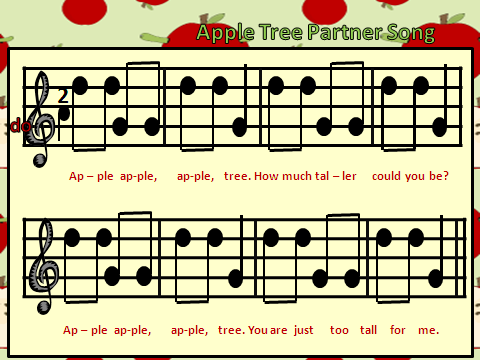
For some extra fun, I added a partner song this year (created by me).  Instructions are included for transferring the song to bass xylophones and also for creating two-part singing music with your students.

I also added cards (as usual) for reconstructing the song (as an assessment).  Here's a picture of the solfa cards (lyrics - rhythm - solfa cards included):
The download also includes notes for teaching and instructions for a fun movement activity.

If you've already downloaded my Do Mi So La Lesson Bundle, you'll find it there (check out my post for more info: Do Mi So La Lessons).  That download includes six other song slides for teaching Do Mi So La and accompanying worksheets, instructions, printables, games, movement suggestions, and instrumentation).

Monday, June 10, 2013

Kuma San


I'm re-doing some lesson plans for my older kiddos (3rd - 5th) because they are finally on track with their grade level (in accordance with Kodaly levels and my favorite series to use, Spotlight on Music).

With this great little song, "Kuma San," I reformated to fit in as much review and vocabulary as possible.  I plan to pair it with Nabe, Nabe.  My 3rd graders will see it again as they work on their recorder rep later in the year.

It has many opportunities for me to assess what my former students have retained and evaluate the musical knowledge of any little newbies I might get.

Here's the PowerPoint I created for it:

You can try using this song while you jump rope, or have the students hop on one foot while saying the song (on the steady beat).  It is lots of fun and kind of silly but even older kids enjoy it.
The song is great for reviewing basic one beat rhythms.  You can have a beat vs. rhythm exercise by having half the students hop on one leg and the other sit and clap the rhythm.  Then switch.
It never hurts to review the musical structures that organize what the students read.  I equate "measures" to "shelves" and the bar lines are the "borders" of the shelves.  Inside each "shelf" lives a certain number of beats, depending on the time or meter signature.

Take a break and add in some unpitched percussion (great time to define the term, review some basic classroom instruments, and define accompaniment or also discuss timbre).  Try having some students clap the blue wood block part while others snap the orange finger cymbal part:

Here's an opportunity for students to review singing on solfa with hand signs (and you can check out any newbies and see if this is ringing a bell or not).  Students enjoy singing this song while touching knees for "do", waists for "re" and shoulders for "mi" - try playing with the tempo for more fun.
This slide (which contains the second half of the melody) offers you the opportunity to discuss phrasing and form.

The last slide offers an opportunity to add in some pitched percussion, plus sneaks in a few more vocabulary words:


What do you do to help your students review previous musical skills and assess the abilities of new students?

Thursday, June 6, 2013

Grandma Grunts


I've always thought this song was  a little silly, but kiddos love the lyrics (and like to act them out).  It is great for adding so back in (or in the first place) after you've taught do-re-mi.

Here are some examples of the slides that are included (38 total):


Slides for introducing pitch

Slides with pitches labeled for singing practice

Pitches on the Staff

Rhythms on the Staff

Final product (version with solfa labeled on it also included)
This fall, when I use it as review with my 3rd graders, I'm going to have them add two ostinatos I created to the song.  They are homo-rhythmic, which means they are a bit easy for the kiddos to sing and play.

Part one can be whistled (depending on their skill level) by some of the boys, as well as played on the BM.  This slide is labeled for instrumental use, but there is also a slide with the solfa labeled.
Part two can be sung by some of the girls, or played on the soprano glock or metallophone.  This slide is labeled for vocal use (although one labeled with absolute pitches is included also):
If you're using this with more advanced students (reviewing with 4th or 5th), they would also enjoy playing the song (and some of the ostinatos too) on the recorder.

Create a form for performance and add some movement and bam - you could put it up on the stage for public consumption. ;)

This slide has been added to my Do Re Mi So lesson bundle which includes 5 other Do Re Mi So songs.